By using our website, you consent to the use of cookies in accordance with our Cookie Policy.

English

Hungarian
English
Our Products

Material Knowledge – 38MnVS6

Material Knowledge – 38MnVS6
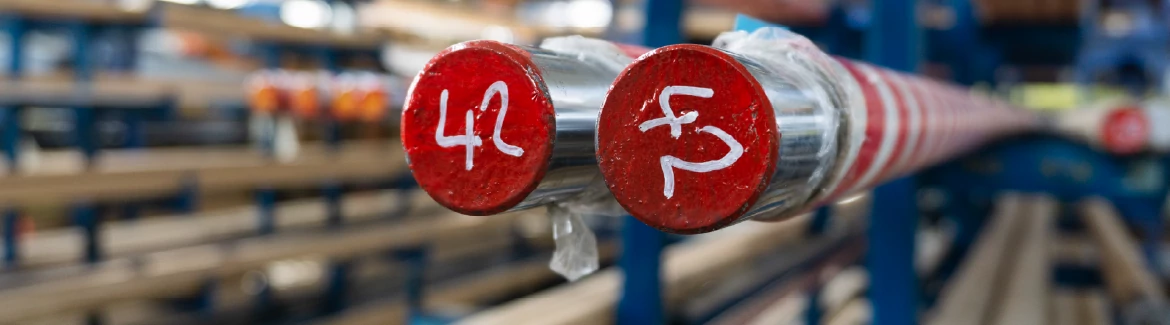
Hero image for the article showing 38MnVS6 round steel bars

Material Knowledge – 38MnVS6: Strength and Precision in Hydraulics and Pneumatics

In hydraulic and pneumatic systems, rods and shafts are crucial components that must withstand extreme loads, friction, and often corrosive environments. In these applications, selecting the right material is essential to ensure durability and reliable operation. The 38MnVS6 steel grade, especially in its hardened and chromed form, offers an excellent solution for these demands.

In this material knowledge article, we will present the composition, mechanical properties of 38MnVS6 steel, the differences between hardened and non-hardened versions, and the advantages of the hard chrome-plated version in hydraulic and pneumatic applications.

Table of Contents

1. General Properties of 38MnVS6 Material Grade

38MnVS6 is a micro-alloyed, medium-carbon steel developed for applications requiring high mechanical properties and a smooth surface.

In the material's composition, manganese (Mn) and vanadium (V) play a particularly important role: manganese increases the steel's strength and hardenability, while vanadium has a grain-refining and precipitation-hardening effect, which significantly improves the material's strength and wear resistance.

In the case of chrome-plated round bars, surface hardness and corrosion resistance can be further increased by surface hardening and hard chrome plating.

Standards and Designations:

  • EN 10267:1998 (38MnVS6): European standard for steels, which regulates ferrite-pearlite steels produced by precipitation hardening from the hot-working temperature.

  • 1.1303: Material number.

  • Similar designations: 39MnV5, 1.1303.

Chemical Composition (typical values according to EN 10267:1998, %):

Element

Content (%)

Role

Carbon (C)

0.34 – 0.41

Essential alloying element that influences strength and hardness during heat treatment.

Silicon (Si)

0.15 – 0.80

Acts as a deoxidizer during steel production, improves strength.

Manganese (Mn)

1.20 – 1.60

Increases the steel's strength and hardness, improves hot workability and hardenability.

Phosphorus (P)

≤ 0.025

Impurity element that can increase the steel's brittleness.

Sulfur (S)

0.020 – 0.060

Impurity element that can reduce the steel's toughness, but in small amounts can improve machinability.

Chromium (Cr)

≤ 0.30

Increases hardness and wear resistance, as well as corrosion resistance, but it is not the primary corrosion protector in this steel.

Molybdenum (Mo)

≤ 0.08

Can increase strength and hardenability.

Vanadium (V)

0.08 – 0.20

Micro-alloying element that refines grains and causes precipitation hardening, significantly increasing the steel's strength and wear resistance.

Nitrogen (N)

0.010 – 0.020

Increases strength and improves mechanical properties.

2. Hardened and Non-Hardened Versions of 38MnVS6: Comparison

During production, 38MnVS6 steel typically gains its mechanical properties as a result of controlled cooling after hot working (e.g., normalization, or precipitation hardening), and does not necessarily undergo conventional quenching and tempering. This steel is often supplied in the so-called "+P" (precipitation hardened) or "+QT" (quenched and tempered) condition, which denotes the final mechanical properties.

  • Non-hardened (e.g., +AR or +N condition): In this condition, the steel is in the "as-rolled" or normalized state. At this point, the strength parameters are lower, but the material is still easily machinable. 38MnVS6 is fundamentally a so-called micro-alloyed steel, which exhibits relatively high strength even in the normal rolled or normalized state due to the refining and precipitation-hardening effect of vanadium.

  • Mechanical properties (in +AR/N condition): Tensile strength (Rm) is typically around 600-750 MPa, and yield strength (Rp0.2) is around 400-500 MPa. Hardness is generally 200-240 HB.

  • Hardened (surface hardened, e.g., induction hardened) or Quenched and Tempered (+QT, +P condition): For hydraulic piston rods, 38MnVS6 steel is often subjected to induction hardening. This surface heat treatment creates an extremely hard layer on the rod's surface, while the core remains tough and flexible. Hardening increases surface wear resistance, bending strength, and fatigue resistance, which is critical in dynamically loaded hydraulic systems. This is followed by hard chrome plating, which provides additional wear and corrosion resistance.

  • Mechanical properties (in +QT / Induction hardened condition):

  • Tensile strength (Rm): Significantly higher, can reach 800-1000 MPa.

  • Yield strength (Rp0.2): Higher, typically above 520 MPa.

  • Surface hardness (after induction hardening, under the chrome layer): Minimum 55 HRC (approximately 600 HV), while the chrome layer itself can have a hardness of over 850 HV0.1.

  • Hardening depth: Depending on the diameter, it can be 1-2.5 mm, which ensures adequate load-bearing capacity.

Comparison:

Property

Non-Hardened (+AR/+N)

Hardened (+QT / Induction Hardened)

Strength

Medium (e.g., Rm 600-750 MPa)

High (e.g., Rm 800-1000 MPa)

Hardness

Lower (e.g., 200-240 HB)

Higher (surface >55 HRC, chrome layer >850 HV)

Wear Resistance

Good

Excellent (especially due to surface hardening and chrome plating)

Fatigue Resistance

Good

Excellent (due to compressive residual stress in the hardened layer)

Ductility

Better (tougher core)

Lower on the surface, but the core retains its toughness

Application

General structural elements, less stressed parts

High-load, parts exposed to wear and dynamic stress (e.g., piston rods)

In hydraulic and pneumatic systems, the hardened and chrome-plated version is used almost exclusively, as surface hardness, wear resistance, and fatigue resistance are critical for the long lifespan of piston rods and other moving parts.

3. Chrome-Plated Round Bars through the Lens of Hydraulics and Pneumatics

Chrome-plated round bars, such as the hardened and chrome-plated version of 38MnVS6, are essential in the manufacture of hydraulic and pneumatic cylinders and other moving parts. The surface treatment, i.e., hard chrome plating, plays a decisive role in performance and lifespan.

  • Hard chrome layer: Usually a minimum of 20 µm thick, this extremely hard (min. 800 HV) and corrosion-resistant layer protects the underlying steel material from wear, scratches, and environmental influences. This layer is vital for the life of seals in hydraulic systems, as it minimizes friction and wear.

  • Surface roughness (Ra): Very low, typically less than 0.2 µm, which contributes to the long-term tightness of seals and the optimal functioning of hydraulic oil.

Main application areas in hydraulics and pneumatics:

  • Piston rods for hydraulic cylinders: This is the most common application, where hardened and chrome-plated 38MnVS6 performs excellently under high-pressure, dynamic loads, and the need for wear resistance.

  • Rods for pneumatic cylinders: Similar to hydraulics, wear resistance and a smooth surface are also essential here.

  • Guide rods and shafts: In machines and equipment where precise movement and high loads are required.

  • Agricultural machinery, construction machinery, mining equipment: In these areas, a robust and durable material is essential due to harsh environmental conditions and high stress.

4. Sustainability and Reliability

Steel, as a material, is outstandingly sustainable thanks to its full recyclability.

Chrome-plated round bars based on 38MnVS6 contribute to the reliability and economical operation of hydraulic systems with their long lifespan, low maintenance requirements, and excellent performance.

The hardened and chrome-plated surface extends the life of the components, reducing the frequency of replacements and waste.

Choose Quality Chrome-Plated Round Bars from Hidraulika Szaküzlet!

In the field of hydraulics and pneumatics, choosing the right material is fundamental to the efficiency and durability of systems. Hardened and chrome-plated 38MnVS6 round bars guarantee reliable operation even under the harshest conditions with their excellent mechanical properties and resistance. At Hidraulika Szaküzlet, we are committed to quality, which is why you will only find the most reliable materials in our offer.

Visit our webshop at hidraulikaszakuzlet.hu and discover our range of chrome-plated round bars! Our expert team is available in Budapest (in person) and online to help you choose the products that best suit your needs.


Labels attached to the content: Anyagismeret Csövek és rudak

Related contents